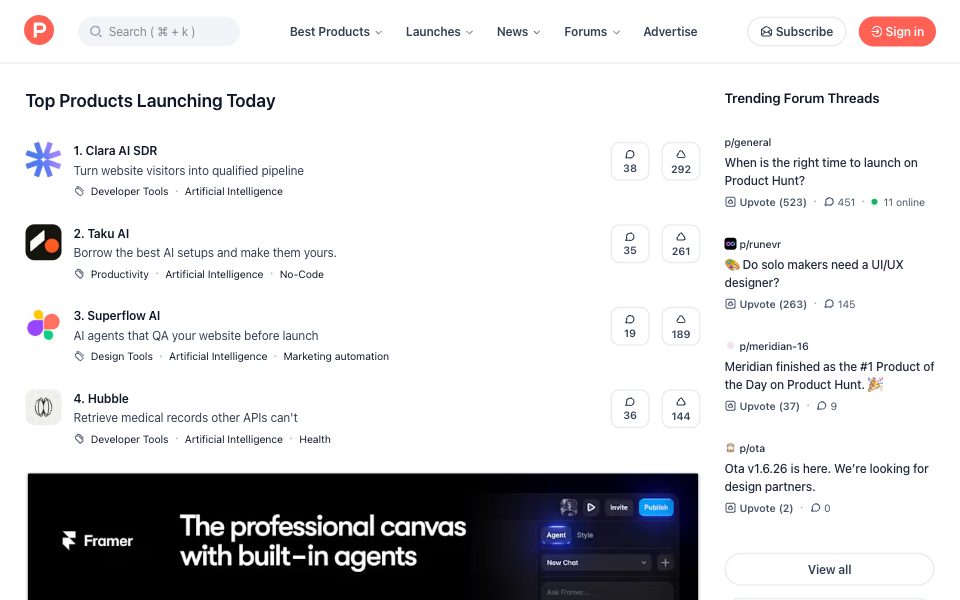
Startup directories are lists of products, usually with a logo, a blurb, categories and a link, that charge for a listing or for a "featured" spot — commonly $50–$300, sold on the promise of a dofollow backlink. Square Town (square.pov.town) is a favicon wall: one permanent 1×1 square that links to your site is free, on a live 3D grid, with no backlink and no ranking claim. The comparison is not about SEO. It is about permanence, price, fun and honesty.
TL;DR — A paid directory listing is a row in a database that someone else may or may not keep online, priced on the SEO value of a link that Google may or may not count. A square is a spot you picked on a wall that anyone can see, for nothing, that stays until someone pays $1 to take it. If you are buying a backlink, buy from a directory and read the fine print. If you want a place to be, claim a square. Do not confuse the two.
At a glance
| Paid startup directories | Square Town | |
|---|---|---|
| What you get | A listing: logo, blurb, category, link; often "featured" placement | One 1×1 square on a shared favicon wall |
| Typical price (Aug 2026) | Free with a badge, $5–$25 one-time, or $50–$300 for featured / "skip the queue"; some bundles $249+ | Free (evict for $1+); $5 optional per-day analytics; Throne from $100 |
| The pitch | "Dofollow backlink", "DR xx", "get discovered" | "1 square = free. Forever (until someone evicts you)." |
| Backlink? | Usually claimed; value depends on the site and whether it survives | No. Clicks are 302 redirects from a canvas |
| Permanence | Until the directory shuts, changes policy or paywalls old listings | Until someone evicts you for double, $1 minimum |
| Position | Sorted by category, date, votes or payment | You pick the cell; location is the game |
| Effort | Form: name, tagline, description, screenshots, categories, sometimes review | Paste URL and email, click cell |
| Feedback loop | Occasional referral hits | Live wall, click/view counter, evictions, kisses, leaderboards |
| Who is it for | Founders buying links and "listings" for the sake of a spreadsheet | People who want their site to exist somewhere public and a little absurd |
What startup directories do well
They are honest about being databases. A good directory has categories, search, screenshots and a page per product, so a human can browse "invoicing tools for freelancers" and find yours. Some have real audiences. Some are curated and refuse junk, which makes being on them mean something. A few charge nothing and ask only for a badge on your site.
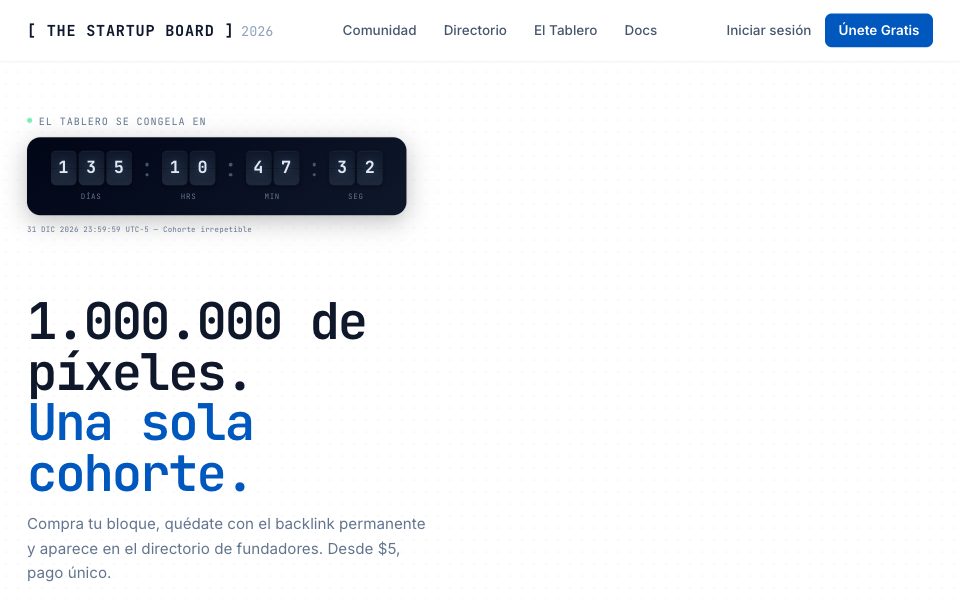
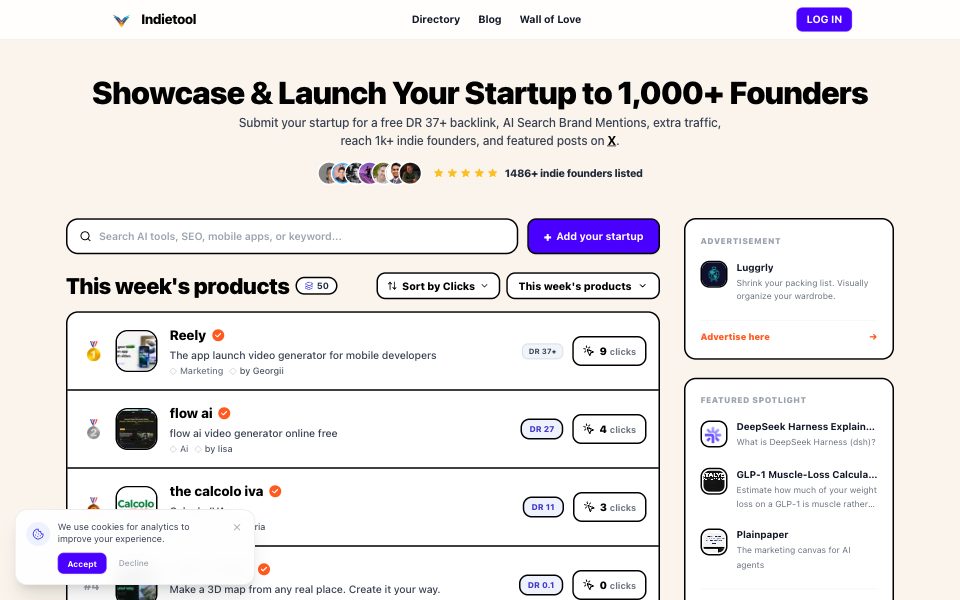
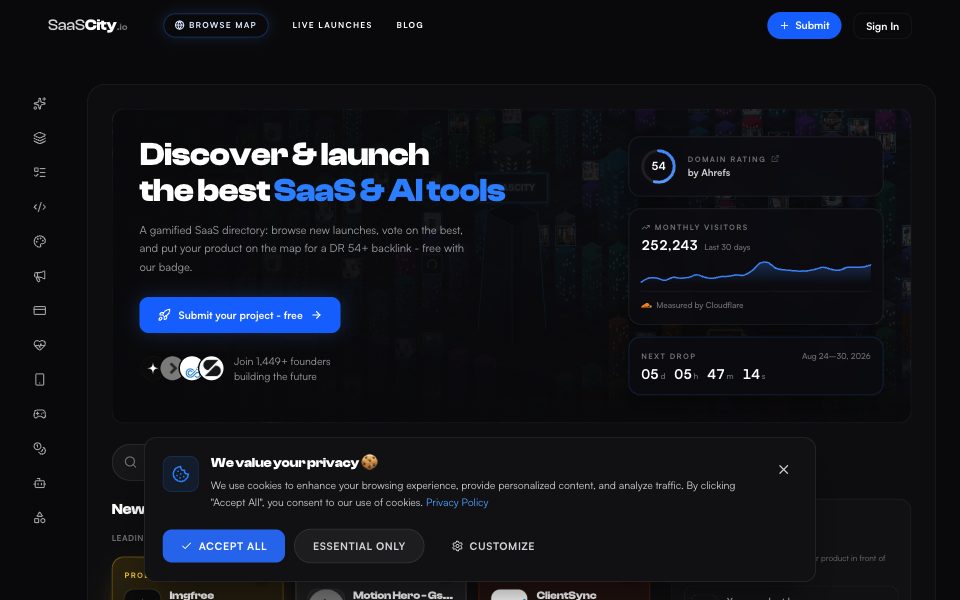
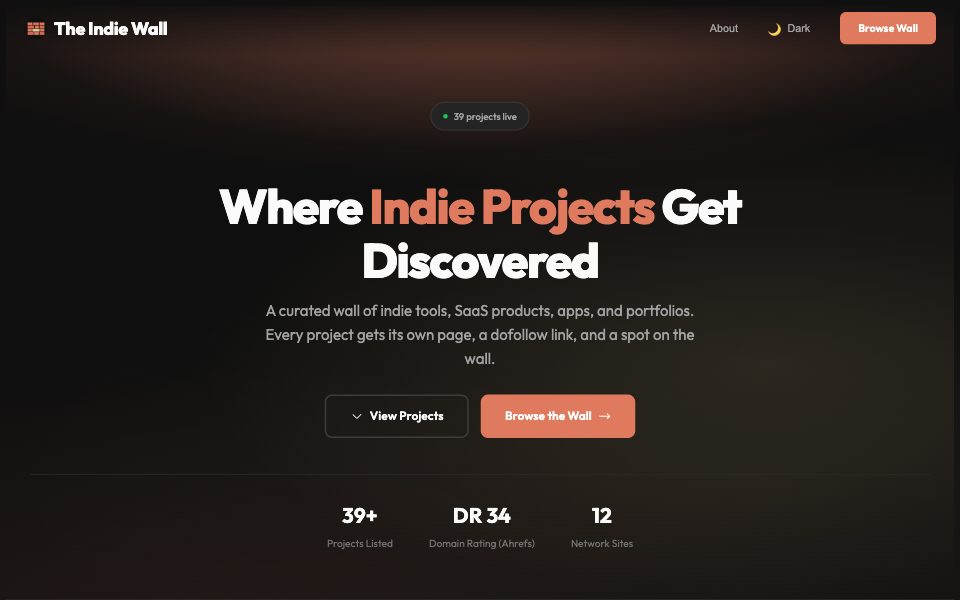
The paid ones are usually selling one of three things: a faster review, a "featured" position, or a link. Prices in the genre range from a few dollars to a few hundred. Among the wall-shaped ones our August 2026 survey found: The Logo Wall ($5 one-time, $10 featured, logo plus profile page plus a dofollow link), The Startup Board ($5 / $25 / $75 tiers of logo size with a dofollow link and founder profile), IndieTool (free with a badge or $19.99 lifetime), SaaSCity (free with badge, $14.99 quick pass, $99.99 premium, on a 3D city map) and The Indie Wall ($249 one-time as part of a backlink bundle). If you decide a listing is worth it, those are at least priced in the open.
What is wrong with the pitch
Most paid directory pitches lean on the backlink. Three problems:
- The link is only worth what the directory is worth. A dofollow link from a site nobody visits, full of links to other sites nobody visits, is a directory link. Search engines have discounted those for a long time. Some directories quietly switch to nofollow or paywall old listings later.
- They die. Directories are cheap to start and cheap to abandon. Our survey of 434 pixel walls and lists found roughly 160 dead and dozens more dormant; directory-style entries were no exception. When the site goes, so does the listing you paid for.
- They are boring. That sounds petty but it is the whole game: nobody visits a directory for fun. Nobody comes back to see who got listed. There is no reason for the audience to exist beyond the founders submitting to it.
Square Town does not fix the first problem — it opts out of it. Square Town is not a backlink product. The wall is a WebGL canvas and every outbound click goes through a counted 302 redirect (/go/:id). There is no link equity to sell, so Square Town doesn't sell it, and any page on this site that hinted otherwise would be lying.
What Square Town does differently
Price. Nothing, per square. Every square is 1×1; there are no sizes, tiers or featured upsells apart from evictions (double what the owner paid, $1 minimum), the Throne (the 4×4 centre, $100 intro price, one owner) and $5 optional per-day analytics on your deed.
Permanence, honestly stated. "Forever*" means no expiry and no subscription — but anyone can evict you by paying double what you paid ($1 minimum), and the next evictor pays double them. Square Town runs on Cloudflare's free tier, which is the boring reason "forever" is credible: there is no hosting bill to lapse.
Position instead of category. You click an empty cell and it is yours. Near the Throne, in a corner, next to a rival — your call. Only the central 16×16 is live at launch and the wall grows by 4 cells in every direction each time it is 75 % full, so central cells only get scarcer.
A reason for anyone to look. The wall is live for everyone: claims, evictions, kisses and ring unlocks appear in every open browser instantly. It tilts into 3D where each favicon is a tower as tall as its clicks plus kisses. There are leaderboards, a Hall of Clowns for sites with no favicon, and a Throne people fight over. That is what a directory can't offer: something happening.
No form. Paste a URL. Square Town fetches your favicon via Google's favicon service. That is the entire submission. (If your site has no favicon you get a clown emoji until you fix it — see What is the Hall of Clowns?.)
Who should pick which
- You are building a backlink profile and tracking DR in a spreadsheet: a directory, ideally a curated one, ideally free. Square Town will not move that number and says so.
- You want a human to find your product by category: a directory with real search and real visitors.
- You want your project to have a public spot that costs nothing and doesn't need maintaining: Square Town. Claim one, keep the deed URL, move on.
- You have ten side projects and no budget: Square Town, ten squares in a row, free. See Square Town for indie hackers: a free square for every side project and 17 places to promote an indie project for under $10 (2026).
- You want ranking, competition and a leaderboard: compare Square Town vs Milliboard: spatial wall or pay-to-rank list? too — a pay-to-rank list is a third option.
Should you use both?
Fine, but for different reasons. List on the free, curated directories that actually have readers; skip the ones whose only pitch is a link. Then claim a square because it is free and it is the only one of these that anyone will ever watch. If you must spend $50–$300, a single well-targeted newsletter sponsorship or a Show HN post you spent an afternoon on will usually beat a featured listing. The full ranked list is at 10 startup directory alternatives for indie developers (2026).
FAQ
Does Square Town give a dofollow backlink like a startup directory?
No. Square Town's wall is a WebGL canvas and clicks are 302 redirects through /go/:id. Square Town is a free permanent favicon square with click and view counts, not link equity. Directories that promise a dofollow link are selling something different.
What do paid startup directories cost in 2026?
Free-with-a-badge is common; one-time listings run about $5–$25 (The Logo Wall $5, IndieTool $19.99 lifetime); featured or "skip the queue" spots commonly $50–$300; bundles like The Indie Wall are $249. Square Town is free per square; evicting one costs $1 and up.
Is a free square permanent?
It has no expiry and no renewal. It can be taken by anyone paying double what you paid ($1 minimum). That fact is in town, not in fine print.
Which is better for getting discovered by category?
A directory with real search and categories. Square Town has no categories; you are a favicon on a grid, plus leaderboards for most clicked and most kissed.
Why is a favicon wall more "honest" than a directory?
Because it does not claim what it can't deliver. Square Town shows you your square's views and clicks, tells you it can be evicted, and does not mention SEO. A directory selling a link is selling an outcome it doesn't control.
Can I list ten projects?
Yes: free, one square per URL, and you can put them next to each other. Each claim gets its own deed URL; keep them.